Tell us about the job
Takes about a minute. No obligation.
Electricity heats more occupied homes in Smith County, Mississippi than any other fuel, at 69.2% (2020-2024 ACS 5-year). An electric water heater runs its heating elements and thermostats through every demand cycle the household puts on it, with no burner, no pilot, and no gas valve to share the load. When a unit fails here, a contractor goes straight to the elements and the upper and lower thermostats, because those are the parts electricity puts under pressure. Sediment buildup at the bottom of the tank shortens element life by forcing the lower element to work harder against an insulating layer. A licensed contractor checks that first, then tests each element under load before pricing any further repair.
Water heaters here sit inside plumbing that in many houses has not changed since the original build. Half the homes in Smith County, Mississippi were built in 1986 or earlier (2020-2024 ACS 5-year). Supply lines, pressure relief valves, and the connections feeding the tank in those older installations accumulate mineral deposits and corrosion that wear a heater from the outside in. A contractor opening a failing unit in this county checks those surrounding components, because a new element or thermostat installed into degraded plumbing fails sooner than the same part would in cleaner conditions.
The Parts of a Water Heater a Contractor Checks During a Repair
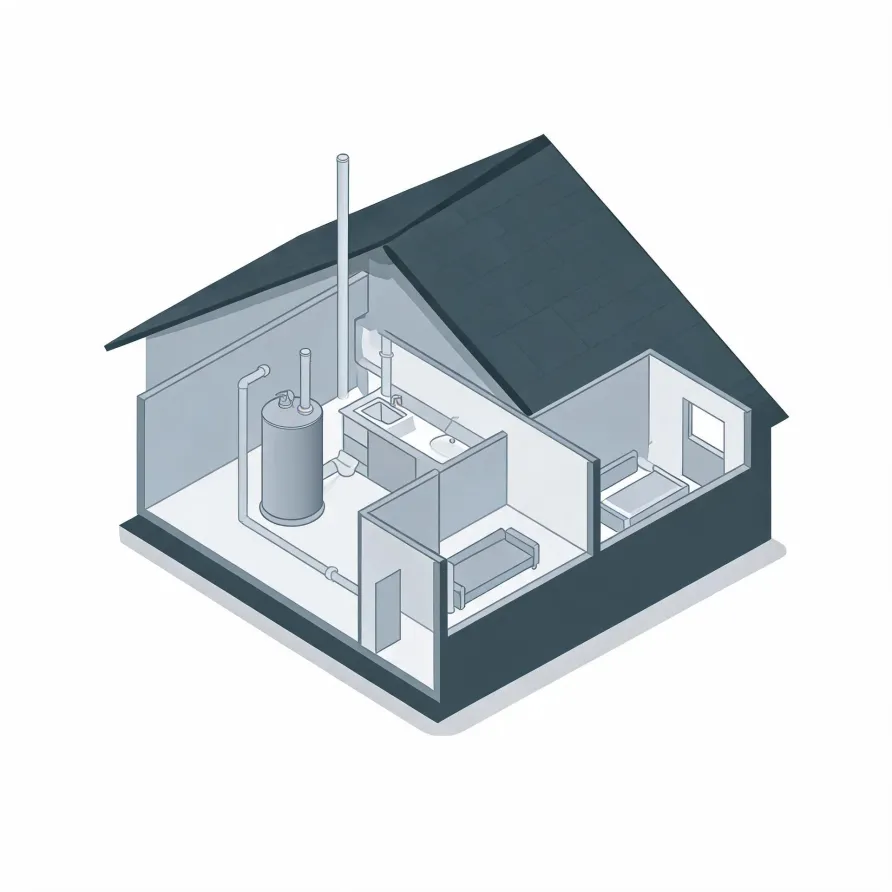
The tank is what most homeowners picture first: a large insulated cylinder that sits in a utility room, basement, or garage and holds the home's supply of heated water. Attached to it are the burner or heating elements, which are the parts a contractor goes to when the water stops getting hot or heats unevenly.
The pressure relief valve mounts directly on the tank and releases if internal pressure climbs past a safe point. The anode rod runs down through the tank's interior and slows corrosion from the inside. The cold inlet and hot outlet connections, along with the thermostat, round out what a contractor examines when tracing a fault.
The drawing shows the general layout of a water heater system, and a licensed contractor determines which parts apply to the specific unit and setup in your home.
Find a contractor in Smith CountySmith County, Mississippi, by the numbers
151 severe weather events were recorded in Smith County, Mississippi between 2015 and 2024.
NOAA National Centers for Environmental Information, Storm Events Database, bulk CSV export, events 2015-01-01 through 2024-12-31.Half the homes in Smith County, Mississippi were built in 1986 or earlier (2020-2024 ACS 5-year).
U.S. Census Bureau, 2020-2024 American Community Survey 5-Year EstimatesSmith County, Mississippi holds 6,714 housing units (2020-2024 ACS 5-year).
U.S. Census Bureau, 2020-2024 American Community Survey 5-Year EstimatesOwners occupy 87.4% of the occupied homes in Smith County, Mississippi (2020-2024 ACS 5-year).
U.S. Census Bureau, 2020-2024 American Community Survey 5-Year EstimatesSevere Weather Events in Smith County
Extreme weather puts water heaters under strain: pressure on storage tanks, sediment churn from temperature swings, and demand spikes after outages all shorten equipment life. How hard the weather hits Smith County shapes how hard local water heaters work.
151 severe weather events, 2015–2024. Source: NOAA National Centers for Environmental Information, Storm Events Database.