Tell us about the job
Takes about a minute. No obligation.
Electric water heaters in this county work alongside electric furnaces and baseboard heaters, all drawing from the same service panel and subject to the same demand swings that come with a heavily electric household. Electricity heats more occupied homes in Webster County, Mississippi than any other fuel, at 47.6% (2020-2024 ACS 5-year). When a water heater fails here, a contractor checks the elements and thermostats first, because those are the parts that cycle hardest in a home where electricity is doing most of the heating work. Sediment buildup around a lower element goes unnoticed until the unit stops recovering, and by then the element has often burned through.
Older plumbing systems in this part of Mississippi were built around equipment that manufacturers stopped supporting long before the systems themselves gave out. Half the homes in Webster County, Mississippi were built in 1983 or earlier (2020-2024 ACS 5-year). When a water heater in stock like this fails and a contractor opens it up, the question that shapes the job is whether the replacement components it takes are still in the supply chain. Valves, anode rods, and heat exchangers spec'd to older standards can run into substitution problems that change what a straightforward repair actually costs and how long it takes to complete.
The Parts of a Water Heater a Contractor Checks During Repair
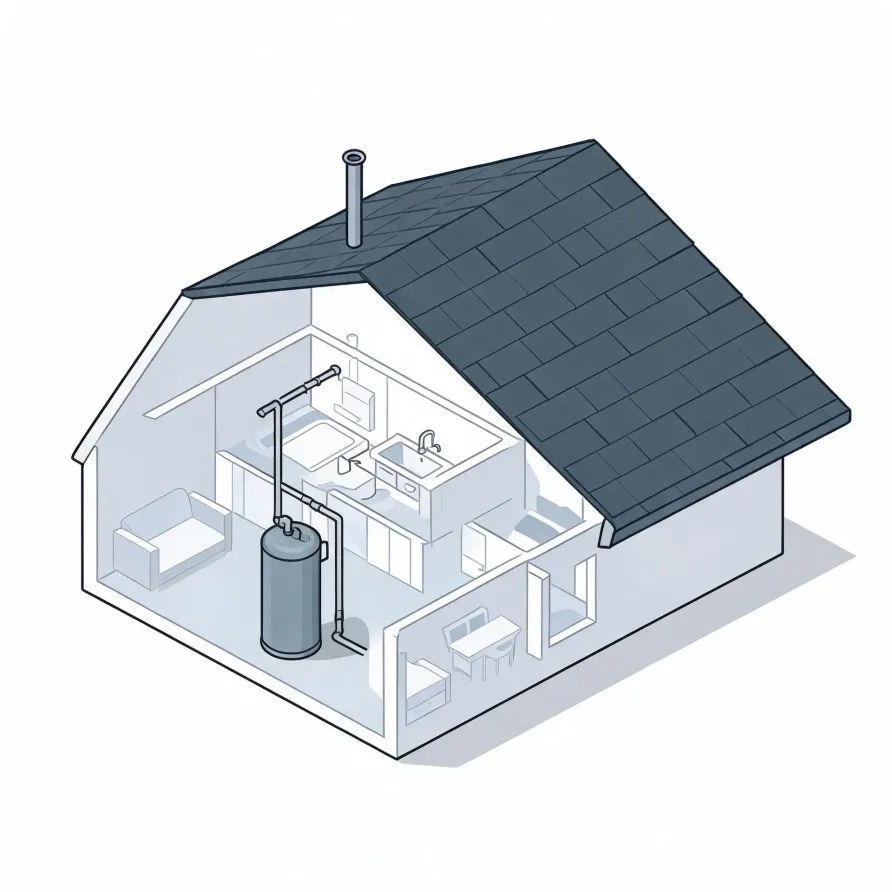
The tank is the piece a homeowner notices first, sitting in a utility room, basement, or garage, holding water at a set temperature around the clock. Attached to it are the heating elements or burner assembly, which do the actual heating, and the thermostat, which tells them when to fire and when to stop.
The pressure relief valve mounts on the side of the tank and opens if pressure or temperature climbs beyond a safe point. The anode rod hangs inside the tank to slow corrosion, and the dip tube runs down through the water to direct cold supply toward the bottom where heating happens.
The drawing shows a general layout of these components, and a licensed contractor determines which ones apply and what condition they are in for your specific unit.
Find a contractor in Webster CountyWebster County, Mississippi, by the numbers
55 severe weather events were recorded in Webster County, Mississippi between 2015 and 2024.
NOAA National Centers for Environmental Information, Storm Events Database, bulk CSV export, events 2015-01-01 through 2024-12-31.Half the homes in Webster County, Mississippi were built in 1983 or earlier (2020-2024 ACS 5-year).
U.S. Census Bureau, 2020-2024 American Community Survey 5-Year EstimatesWebster County, Mississippi holds 5,114 housing units (2020-2024 ACS 5-year).
U.S. Census Bureau, 2020-2024 American Community Survey 5-Year EstimatesOwners occupy 76.1% of the occupied homes in Webster County, Mississippi (2020-2024 ACS 5-year).
U.S. Census Bureau, 2020-2024 American Community Survey 5-Year EstimatesSevere Weather Events in Webster County
Extreme weather puts real stress on water heaters, forcing the equipment to work harder and recover faster than it was sized to handle. How much of that pressure lands on a home in Webster County depends on what the local record actually shows.
55 severe weather events, 2015–2024. Source: NOAA National Centers for Environmental Information, Storm Events Database.